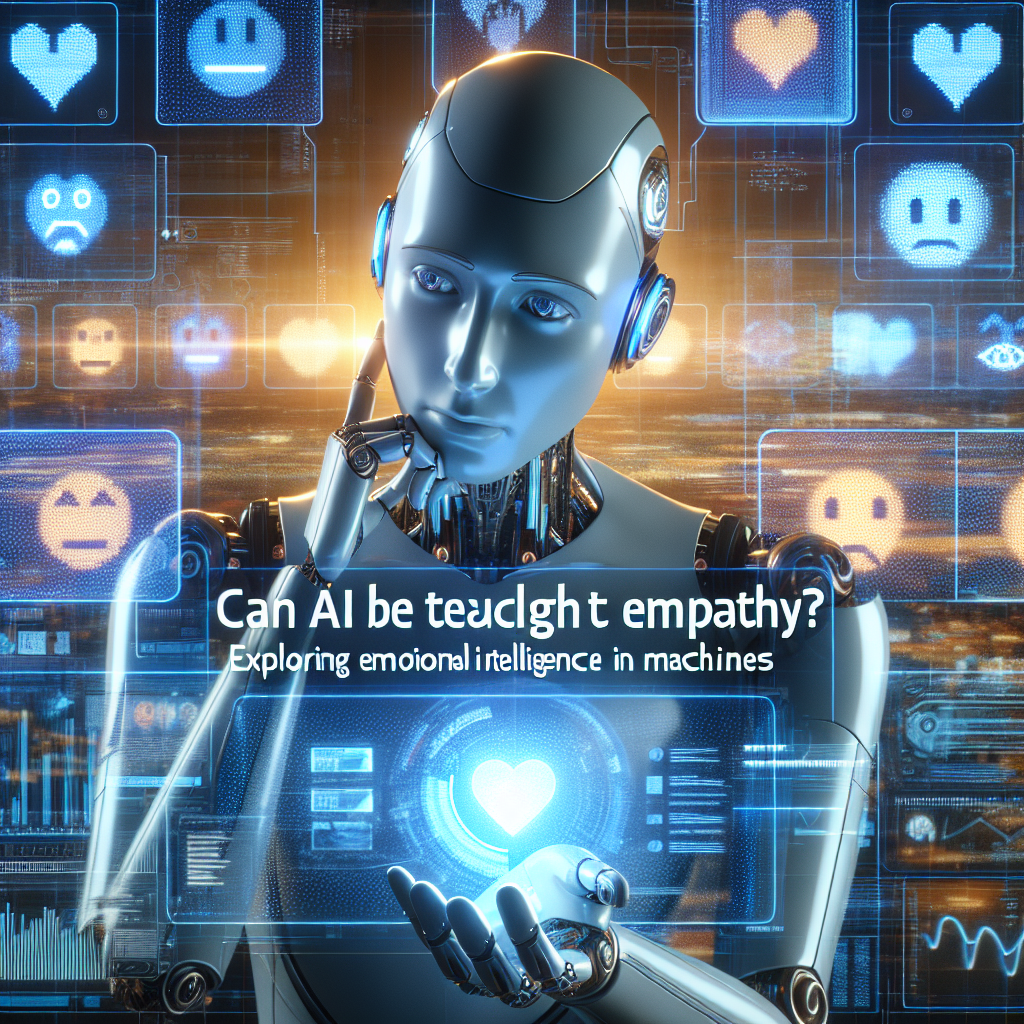
In recent years, discussions surrounding artificial intelligence (AI) have transformed from mere fascination to serious contemplation of its implications on society. Among these discussions, one of the most intriguing questions arises: Can AI be taught empathy? Emotional intelligence, a trait traditionally associated with humans, may play a critical role in the development of AI systems. This article delves into the complexities of teaching empathy to machines, exploring the relationship between AI and emotional intelligence, while examining ethical implications and potential applications.
Understanding Empathy in Humans
What is Empathy?
Empathy is a multifaceted emotional experience that enables individuals to understand and resonate with the feelings of others. According to psychologist Daniel Goleman, empathy comprises two key components: cognitive empathy (the ability to understand another’s perspective) and emotional empathy (the capacity to share and respond to another’s emotions). This nuanced skill enhances interpersonal relationships and fuels compassionate actions, making it a cornerstone of human interaction.
The Importance of Emotional Intelligence
Emotional intelligence (EI) refers to the ability to identify, comprehend, and manage one’s own emotions while also recognizing and influencing the emotions of others. High emotional intelligence is often linked to effective communication, conflict resolution, and leadership. In an age where technology mediates much of our interactions, the question emerges: can AI embody aspects of emotional intelligence, particularly empathy?
The Intersection of AI and Emotional Intelligence
Current Capabilities of AI
AI systems have made remarkable strides in recent years, demonstrating capabilities such as natural language processing, image recognition, and data analysis. However, their understanding of human emotions remains limited. Most AI systems operate on algorithms and data, lacking the intrinsic emotional awareness that characterizes human empathy.
Natural Language Processing and Sentiment Analysis
Natural language processing (NLP) plays a crucial role in allowing AI to interact with humans. Through sentiment analysis, AI can analyze text for emotional indicators, enabling applications like customer support chatbots to identify frustrated customers and respond accordingly. However, while these systems can mimic empathetic responses, they do not truly “feel” emotions; their responses are patterned and programmed, not genuinely compassionate.
Machine Learning and Neural Networks
Machine learning, particularly through neural networks, allows AI to learn from patterns in data. By training on historical interactions, AI can improve its responses over time. But learning empathy is not merely a data-driven task; it involves understanding complex human emotions, which are often situational and context-dependent.
The Challenges of Teaching Empathy to AI
Defining Empathy for AI
One of the foremost challenges in teaching empathy to AI is the inherent ambiguity in defining it. Empathy involves subjective experiences and deep emotional connections, which are difficult to quantify or program. Creating a universally accepted model of empathy for machines requires interdisciplinary collaboration between psychology, neuroscience, and computer science.
Emotional Context and Complexity
Human emotions are intricately nuanced. Cultivating a deep understanding of context, culture, and individual backgrounds is essential for true empathetic responses. Although AI can analyze patterns and predict likely outcomes, achieving contextual awareness akin to human understanding poses significant challenges.
Ethical Considerations
The Risk of Manipulation
The potential for manipulating emotions through AI raises ethical concerns. AI systems designed to understand and influence human emotions could inadvertently mislead individuals or manipulate their feelings for commercial gain. This highlights the responsibility of developers in ensuring that AI applications prioritize ethical standards in their design.
The Risk of Overreliance on AI
As AI systems grow more advanced, the risk of overreliance on technology for emotional support increases. While an AI may simulate empathetic conversations, it lacks the depth of human connection. Overreliance on AI for emotional well-being could detract from authentic human interactions, leading to social isolation.
Practical Applications of Empathetic AI
Despite the challenges, the pursuit of empathetic AI holds potential benefits across various sectors.
Healthcare
In healthcare, empathetic AI could assist in patient diagnoses and emotional support. Virtual health assistants using natural language processing and sentiment analysis can identify patient concerns, provide necessary information, and monitor mental well-being. This technology not only enhances patient care but also helps healthcare providers better understand their patients’ emotional contexts.
Customer Service
Customer service is another domain where empathetic AI can play a vital role. AI-driven chatbots that understand customer sentiments can improve interactions and customer satisfaction. By responding appropriately to emotional cues, these systems enhance consumer experiences and foster brand loyalty.
Education
In the education sector, empathetic AI could support students by providing personalized learning experiences. AI tutors capable of recognizing frustration or boredom can adapt their teaching methods, leading to more effective learning. Moreover, empathetic interactions can bolster students’ emotional well-being, creating a supportive learning environment.
The Future of Empathetic AI
Ongoing Research
Research in AI and emotional intelligence is ongoing, with many interdisciplinary collaborations exploring the nuances of empathy. Efforts are being made to incorporate affective computing—enabling machines to recognize and respond to human emotions. However, challenges will continue to arise as we navigate ethical, contextual, and technological dimensions.
Potential Frustrations
The path to developing empathetic AI is fraught with frustrations and setbacks. For instance, the complexity of human emotions and context often leads to misinterpretations. Moreover, as technology evolves, societal expectations of what AI can achieve will continually shift, putting pressure on developers to meet these demands.
The Human Factor
Despite advancements, it is essential to recognize that AI can never fully replicate human empathy. While technology can enhance human experiences, fostering genuine relationships and understanding emotions will always require human involvement. AI resources should be seen as complements to our inherent emotional capabilities.
Conclusion
Can AI be taught empathy? While significant strides can be made in developing emotionally intelligent machines, the limits of AI’s understanding must be acknowledged. The pursuit of empathetic AI presents both challenges and opportunities, urging developers to examine the ethical implications of their technologies. As we explore this promising frontier, it is crucial to retain the essence of authentic human connections, ensuring that technology enhances, rather than replaces, our emotional experiences.
Final Thoughts on the Future of AI and Empathy
In a world where technology increasingly shapes our interactions, the quest for empathetic AI presents a unique challenge. It raises fundamental questions about the nature of understanding and connection. As researchers and technologists push the boundaries of what AI can achieve, the dialogue surrounding empathy remains vital. Thus, the potential for AI to be taught empathy exists, but the journey toward this goal will require careful consideration, ethical responsibility, and a commitment to preserving what makes us fundamentally human.
This article covers the prospects and complexities of teaching empathy to AI, using relevant keywords such as “empathy,” “artificial intelligence,” “emotional intelligence,” and more throughout the text. It’s structured to enhance SEO while providing clear, informative content that adheres to Google AdSense’s content policies.