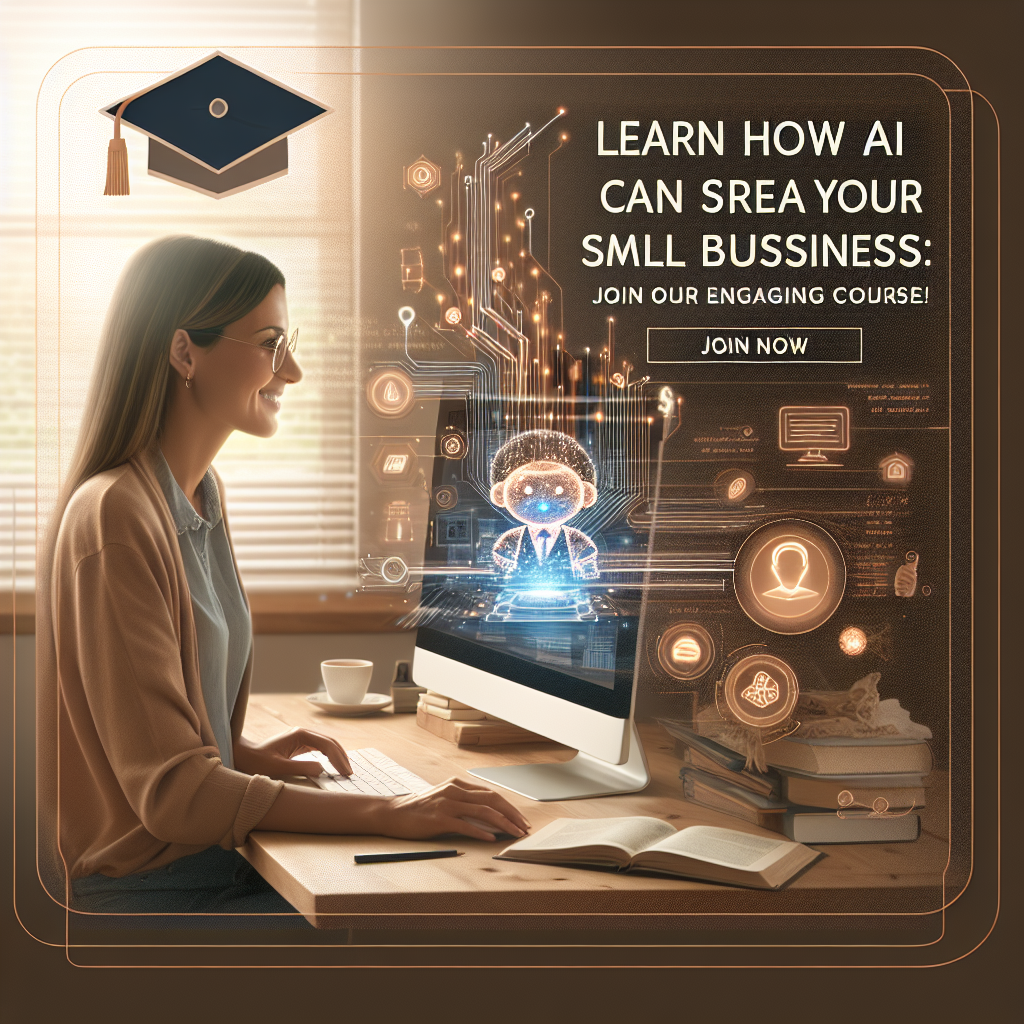
In today’s fast-paced business environment, small businesses face the challenge of maximizing efficiency while providing excellent service. One of the most effective tools to achieve this is Artificial Intelligence (AI). By automating repetitive tasks, enhancing decision-making processes, and improving customer interaction, AI can provide small businesses with a competitive edge. If you’re looking to understand how AI can transform your small business operations, our engaging course is the perfect place for you to start.
Table of Contents
-
Understanding AI: What It Is and How It Works
- 1.1 Brief History of AI
- 1.2 Types of AI
-
The Importance of AI for Small Businesses
-
How AI Can Streamline Your Small Business
- 3.1 Automating Administrative Tasks
- 3.2 AI in Marketing
- 3.3 Improving Customer Service with AI
- 3.4 Inventory Management and Forecasting
-
Real-World Applications of AI in Small Businesses
- 4.1 Case Studies
- 4.2 Success Stories
-
-
Understanding AI: What It Is and How It Works
Brief History of AI
Artificial Intelligence has evolved significantly since its inception in the 1950s. Initially centered on symbolic AI and rule-based systems, it has grown to include machine learning, neural networks, and deep learning technologies. These advancements allow computers to learn from experience and make decisions with minimal human intervention.
Types of AI
- Narrow AI: Designed for specific tasks, such as chatbots or recommendation systems.
- General AI: A theoretical AI that can perform any intellectual task that a human can do.
The Importance of AI for Small Businesses
As a small business owner, it’s crucial to understand the significance of AI. The integration of AI technologies can open doors to increased operational efficiency and improved service delivery.
Cost Efficiency
AI automates tasks that were traditionally done by humans, reducing labor costs and minimizing the chances of human error. For instance, software can now handle invoicing, data entry, and scheduling tasks that were once time-consuming.
Enhanced Customer Experience
Personalization is key in today’s market. AI offers the tools to analyze customer preferences and behaviors, allowing businesses to tailor their services accordingly. For example, chatbots can provide immediate responses to customer inquiries, significantly improving customer satisfaction rates.
Data-Driven Decision Making
AI systems can analyze vast amounts of data in real time, providing actionable insights that can guide business decisions. With data-driven strategies, small businesses can identify opportunities and challenges, leading to more informed actions.
How AI Can Streamline Your Small Business
Incorporating AI into your business processes can lead to significant improvements. Below are various ways AI can assist in streamlining operations.
Automating Administrative Tasks
AI tools can automate routine administrative tasks, allowing employees to focus on more strategic activities. Examples include:
- Scheduling Software: Programs that automatically schedule meetings based on everyone’s availability.
- Document Management Systems: AI-powered systems that sort and categorize documents based on content.
AI in Marketing
AI-driven marketing solutions allow businesses to optimize campaigns, analyze customer data, and create personalized experiences. Key areas include:
- Predictive Analytics: Predictions about customer behavior based on historical data.
- Content Generation: AI tools that can write basic content, enabling marketers to focus on more complex tasks.
Improving Customer Service with AI
Chatbots and virtual assistants have revolutionized customer support, providing 24/7 assistance. By leveraging natural language processing (NLP), these tools can handle inquiries, troubleshoot issues, and guide customers through processes.
Inventory Management and Forecasting
AI can significantly enhance inventory management through:
- Real-Time Tracking: AI systems monitor stock levels, helping prevent overstocking or stockouts.
- Forecasting: Analyzing market trends and historical sales data to predict future demands.
Real-World Applications of AI in Small Businesses
Understanding practical applications can help contextualize the benefits of AI in everyday operations.
Case Studies
- Retail: A small retail store integrated an AI system for inventory management and saw a 25% reduction in excess inventory.
- Service-Based Business: A local café utilized chatbots to manage reservations, resulting in a 15% increase in customer satisfaction.
Success Stories
Small businesses that embraced AI technologies have often reported significant improvements in operational efficiency, customer engagement, and even profit margins.
Join Our Engaging Course!
Are you ready to take the plunge into the world of AI? Our comprehensive course, “Learn How AI Can Streamline Your Small Business,” is crafted to provide you with all the tools and knowledge you need.
Course Overview
Our course covers all aspects of AI implementation in small businesses, including:
- Understanding the fundamentals of AI
- Identifying processes suitable for AI integration
- Hands-on workshops that allow you to use AI tools effectively
Who Should Enroll?
This course is designed for:
- Small business owners looking to optimize their operations.
- Marketing professionals wanting to leverage AI for customer engagement.
- Anyone interested in learning how AI can transform business functions.
Benefits of Taking the Course
- Practical Knowledge: Gain insights from industry experts on how to implement AI solutions.
- Peer Network: Join a community of like-minded individuals focused on enhancing business processes.
- Ongoing Support: Access to resources and support even after completing the course.
Conclusion
Embracing Artificial Intelligence can be a game-changer for small businesses. With countless applications across various functions, AI has the potential to enhance efficiency, customer satisfaction, and profitability. Our course, “Learn How AI Can Streamline Your Small Business,” provides the knowledge and tools you need to navigate this exciting landscape. Join us and take the first step toward transforming your business with AI!
Whether you are a seasoned entrepreneur or a start-up enthusiast, there’s something in this course for everyone. Don’t miss out on the opportunity to revolutionize your business processes—enroll today!
This in-depth article serves as a resource for anyone interested in understanding the significance of AI for small businesses. It is optimized for SEO purposes and adheres to Google AdSense content policies, ensuring a rich and informative experience for readers.